AI Video Interview Software Just Folded Three Rounds Into One. Who Owns the Verdict?
AI video interview software now folds three hiring rounds into one score. Here's a 3-step check to keep a human in charge of the final call.

Knoot Admin
October 09, 2026
Content
Why one AI interview is riskier than three human ones
One round, one point of failure
The report reads like a verdict
Nobody wrote down what it's scoring
Same bias, faster
The candidate emails back
The 3S Check: keeping humans in charge of AI interview software
Spell it out
Show the work
Stop button
The Knoot Angle
Priya runs TA at a 60-person fintech. Her open role: Senior Backend Engineer. For years that meant three rounds. A recruiter screen. A take-home. An engineer follow-up. Three people, three chances for someone to notice something off.
AI video interview software used to record answers and wait. This week it crossed a line. HackerRank launched an AI interviewer that asks follow-up questions, watches how candidates work, and folds all three rounds into one session. A report lands in the hiring manager's inbox with a score.
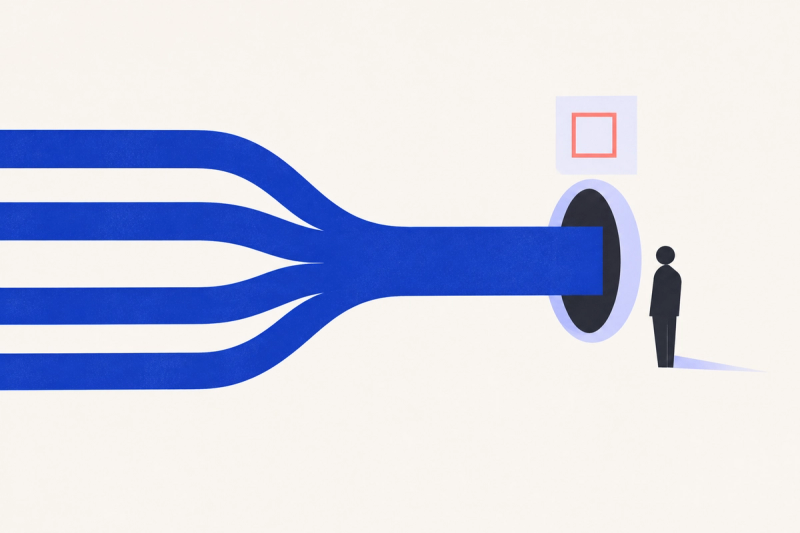
Three doors became one. So who's checking the lock?
Why one AI interview is riskier than three human ones
One round, one point of failure
Priya's old pipeline took nine days. Annoying. Also redundant in a useful way: if the recruiter missed something on day one, the engineer might catch it on day nine.
The new pipeline takes one Tuesday afternoon. Faster, yes. But now you have one judgment. One model. One rubric. One report.
Single point of judgment = single point of failure.
The report reads like a verdict
A score with two decimals feels like a fact.
It's an opinion in a nice font.
Hiring managers skim. Skimmed opinions become decisions. And a decision that started as a skim rarely gets a second look.
Nobody wrote down what it's scoring
Ask Priya what "strong judgment" means inside the rubric. Silence. She approved a vendor, not a definition.
- Criteria: undocumented.
- Weights: invisible.
- Overrides: awkward.
When the AI interviewer asks a follow-up about how a candidate would handle a new constraint, what is it actually listening for? If you can't answer, you're not running an interview. You're outsourcing one.
Same bias, faster
Applying one standard to every candidate sounds fair. It is, as long as the standard is. A biased rubric applied to 400 people in a week doesn't average out. It scales.
The candidate emails back
"Why was I rejected?" You open the report. It says 62.
We dug into earlier this month. The interview is just the newest place the question shows up.
The 3S Check: keeping humans in charge of AI interview software
You don't need a vendor to run this. A shared sheet and thirty minutes will do. Run it before any AI scores a single candidate, and again whenever the tool or the role changes.
Spell it out
Write the criteria down before the AI touches a candidate.
- Must-haves: five, max.
- Weights: add up to 100.
- Dealbreakers: named.
Then show the hiring manager and get a yes. The point isn't paperwork. It's making the disagreement happen now, before the first interview, not after the third rejection.
If you can't write it, the tool can't fairly score it.
Priya's version for the backend role: system design 30, debugging under pressure 25, communication 20, API craft 15, ownership 10. Dealbreaker: can't explain a trade-off they made. Ten minutes to write. It changed which candidates she trusted.
Show the work
Every score needs a reason a hiring manager can read in ten seconds.
No reason, no score.
"62" is a number. "Strong on system design, thin on failure handling" is evidence. The first one ends a conversation. The second one starts the useful one. If your vendor can't produce the second kind of sentence for every candidate, that's a finding, not a footnote.
Stop button
Name one human who can overrule any score. Write their name next to the role. Log every overrule and review the log monthly.
If the overrule count is zero, you don't have oversight. You have a rubber stamp.
The Knoot Angle
AI can run the conversation. It shouldn't own the conclusion.
Knoot doesn't run your interviews. It works one step earlier, where the same question starts. Knoot's AI Screening module compares every candidate against the criteria you set, never screening blind. You get a ranked shortlist with match percentages, and a plain-language reason behind each one.
It also surfaces risk flags: timeline overlaps, skill claims that don't match the experience around them. Flags, not rejections. Every call stays with you.
That's the 3S Check built into the workflow: criteria spelled out, work shown, and a human holding the stop button.
The AI does the reading. You keep the verdict.
Content
Why one AI interview is riskier than three human ones
One round, one point of failure
The report reads like a verdict
Nobody wrote down what it's scoring
Same bias, faster
The candidate emails back
The 3S Check: keeping humans in charge of AI interview software
Spell it out
Show the work
Stop button
The Knoot Angle