Your Candidate Database Isn't an Asset. It's a Liability You Haven't Been Fined For Yet.
Your candidate database isn't an asset until you control it. Here's a 3-gate test — and what talent pool recruitment software should really do.
Knoot Admin
Knoot Admin
September 29, 2026

You call it your candidate database.
A data regulator calls it personal information you're holding with no reason left to hold it.
Every recruiter has one. A Drive folder full of CVs. An ATS with profiles from 2021. A few thousand contacts exported to a spreadsheet “just in case.” You've been told this is an asset. More CVs, more options, more leverage.
But in 2026 the rules changed. Candidate data isn't an asset by default. It's an asset only when you know why you're keeping it, that you're allowed to keep it, and when it has to go.
Everything else is a liability. You just haven't been fined for it yet.
Why “more CVs” quietly became a risk
For years, recruiters were taught one rule: never delete a CV. You might need it later.
So everyone became a hoarder.
The problem is the data you hoard doesn't sit still. It ages, it rots, and it turns into risk.
You're holding data you don't remember having
Someone applied in 2021 and got cut in round one. Their CV is still in your Drive. Email, phone number, salary expectation — all still there.
You don't remember them. You never got permission to keep them this long.
If they emailed you “delete my data,” could you even find it across 30 folders?
Old data is worse than no data
The number's changed. They've switched jobs twice. The skills on that 2021 CV mean nothing now.
You shortlist off a snapshot of the past, then wonder why your response rate is zero.
“Keep everything” isn't a strategy — it's avoidance
Everyone knows a messy pile of data is a risk. But cleaning it is work, so it sits there.
Wrong.
That un-cleaned pile is exactly what costs you time now — and one day, money.
How to turn a data dump into an actual talent pool
A talent pool isn't the place you dump every CV and forget it.
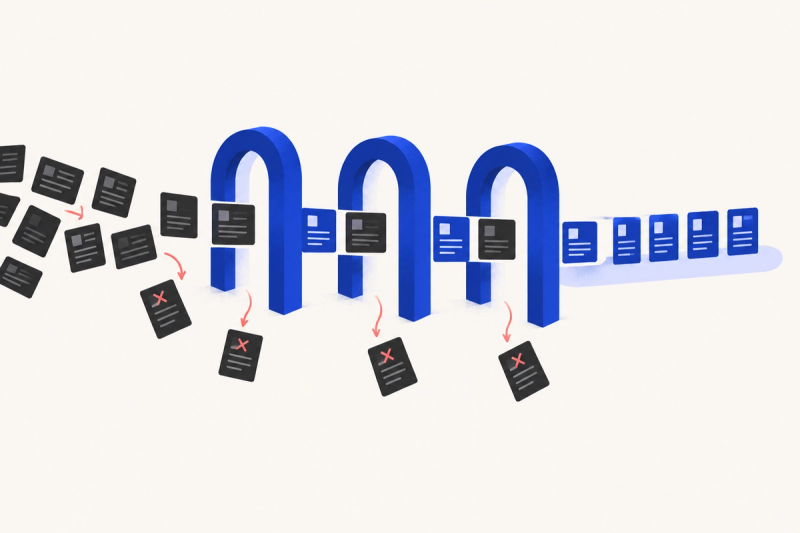
It's the place where every profile can answer three questions. Call it the 3-Gate Test: Purpose, Permission, Lifespan.
Before a profile earns a spot in the pool, it clears three gates:
Gate 1 — Purpose
Why are you keeping this profile?
- For a specific role?
- For a role cluster you hire for often?
- Or just “in case”?
If the answer is “in case,” it doesn't belong in the pool. It belongs in the bin.
Gate 2 — Permission
Does the candidate know you're holding their data?
Keeping a CV they sent you last month is one thing. Sitting on a contact you scraped somewhere three years ago is a completely different thing.
A clean pool is one you'd be comfortable letting the candidate see.
Gate 3 — Lifespan
Every profile should have an expiry date.
- When did you last talk?
- Is this data still true?
- Time to refresh, or time to delete?
A living talent pool shrinks on purpose. It doesn't only grow.
You don't need 5,000 profiles.
You need 300 you know cold — why you kept each one, and any of whom you could call today.
The Knoot Angle
In 2026, a good talent pool isn't measured by how many profiles you've stockpiled. It's measured by how many of them you actually control.
If your candidate data is scattered across Drive, spreadsheets, and old email threads — where you don't know what you're holding or why — Knoot's Private Talent Pool is built for exactly that.
- One place: every CV and profile in a single space, searchable by keyword and filter in seconds — no more “which folder was that in?”
- Real structure: each profile is parsed and organized by role, skill, and target group, so you always know what you have and why you're keeping it.
- Notes and interaction history: you know when you last touched a candidate, and which data has gone stale and needs a refresh.