Knoot Drama

Knoot Town

Career

Skill Station

Podcasts

Applications Are Claims. Talent Community Software Is Your Second Source.

Applications are claims now. Talent community software helps recruiters add a second source: a Said, Showed, Vouched check before any shortlist.

Knoot Admin

Knoot Admin

November 03, 2026

Content

Why a bigger pile tells you less

The page is the only witness

Polish is free

You re-screen strangers

A second-source rule for any talent community software or spreadsheet

The Said / Showed / Vouched check

Said

Showed

Vouched

The Knoot Angle

blog image
Monday, 8:40. Coffee still hot.
Three hundred and twelve applications landed on one Senior Backend role since Friday. You open the first ten.
Same verbs. Same "led cross-functional initiatives." Same tidy bullets, down to the comma placement.
Nobody lied. Everybody just got help.
An application is a claim now, and claims got cheap. So what does your ATS check when every claim reads the same? What does your talent community software check? What do you?

Why a bigger pile tells you less

You didn't get more information on Friday. You got more of the same information, in more polished packaging.

The page is the only witness

Your ATS stores what the candidate wrote. Your screening reads what the candidate wrote. Everything downstream grades one document, authored by the one person with the most to gain.
Twelve witnesses. One script.
Say you open ten and pick four. All four have a clean summary and a confident verb. You book four calls, burn two hours, and learn on call three that "led a team of eight" meant "sat near a team of eight."
That's an afternoon spent on a sentence nobody checked.

Polish is free

A clean CV used to signal effort. Now it signals a subscription.
Fluent, keyword-matched, well-formatted. That describes the candidate who is perfect for the role, and also the one who isn't. The page can't tell them apart.

You re-screen strangers

The silver medalist from March? Back in the pile. A fresh claim, no memory, no history, no one in your network who ever said "I worked with her."
You already paid to learn she was strong. This time you pay again, because nothing about that first conversation travelled with her. The pile has no memory, and neither does the spreadsheet next to it.
Speed doesn't fix this:
  • Faster reading.
  • Faster ranking.
  • Same single source.
You're now wrong more quickly.
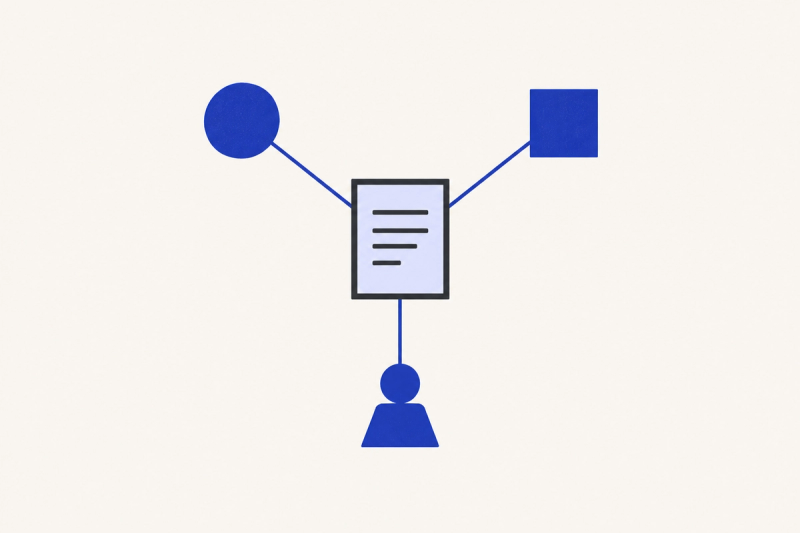
blog image

A second-source rule for any talent community software or spreadsheet

A journalist doesn't publish on one source. A recruiter shortlists on one every day.
Rules beat tools here, because the tool only works on whatever signal you feed it. The fix doesn't need a new tool. It needs a rule you can run in a Google Sheet by lunch.

The Said / Showed / Vouched check

Every candidate gets scored on three kinds of signal. Only one of them is written by the candidate.

Said

What the candidate wrote. CV, cover letter, profile. This is where you start, never where you finish.

Showed

Evidence in the work itself. A repo. A portfolio. A short case write-up. A 30-minute task scoped to the role.
Start where the candidate already works in public: commits, talks, shipped products, a write-up they didn't write for you.
Showed is harder to fake than Said. It's also slower to collect, so spend it where it counts. Keep any task under half an hour, or good candidates walk.

Vouched

Someone who worked with them says so. A former colleague. Another recruiter who interviewed or placed them. One line, with a name attached.
Vouched is the cheapest signal to collect and the hardest to fake at volume.
It comes from three places: your own call notes, the recruiter who placed her last year, and the hiring manager who passed on her for timing, not fit. Write each one down the day it happens. A vouch you don't record is a vouch you'll have to earn again.
The rule: nobody reaches the shortlist on Said alone. Two of three, every time.
Try it on the next role. Take your top ten from the pile and ask one question per name: what do we have that the candidate didn't write? If the answer is "nothing" for six of them, you just learned something about your shortlist before spending a minute on the phone.
Add three columns to your sheet: Said, Showed, Vouched. Write who vouched and for what, in one line. Within a week you'll see which shortlists were solid and which were costumes.
Here's the catch. Vouched lives in your head and your inbox. It leaves when you do.
And it doesn't scale past the people you personally know, which is a small slice of the people applying.

The Knoot Angle

Recruiting was always a trust business. The paperwork just stopped carrying the trust.
That's the gap Talent Community in Knoot is built around. It's a shared candidate pool where recruiters contribute profiles, so a candidate isn't a stranger every single time. You preview a structured profile with an AI Candidate Summary before you unlock anything, and the original CV and personal details stay hidden until you do. Other recruiters' feedback on a candidate sits alongside the profile, so your Vouched column isn't limited to the people you personally know.
AI surfaces the fit. You still decide who's worth a call.
Let the page make the claim. Let people make the case.
Knoot.AI blog: Applications Are Claims. Talent Community Software Is Your Second Source.