Structured Interview Software Won't Cut Your Interview Count. A Round Map Will.
Interviews per hire are up 33% since 2021. Structured interview software won't fix it. Map one criterion to one round and cut the extra ones.

Knoot Admin
November 03, 2026
Content
The extra round is a missing decision
Every round asks the same three questions
"Not sure yet" turns into "one more round"
The scorecard lives in someone's head
The candidate pays for it
Software inherits the mess
The Round Map: Build It Before You Buy Structured Interview Software
Name 4 to 6 criteria before round one
Give each criterion exactly one home round
Score every criterion on one shared scale
Retire any round that tests nothing new
Write the pass bar before you meet anyone
Score before the debrief
The Knoot Angle
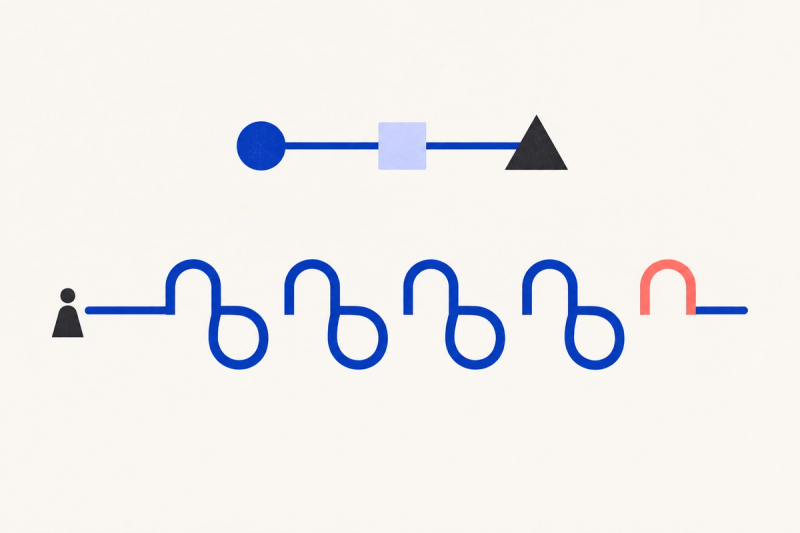
Round one: the recruiter screen. Round two: the hiring manager. Round three: the panel. Round four: "just a quick chat" with the VP.
Now ask each interviewer what they were testing. You'll get four versions of "culture fit and communication."
Gem's 2026 recruiting benchmarks put interviews per hire up 33% since 2021, while the average recruiter juggles about 13 open roles. More rounds, more roles, same number of hours in the day.
Structured interview software is the usual answer. It isn't the fix.
The extra rounds aren't rigor. They're repeated questions with nobody keeping score.
So why does every process keep growing?
The extra round is a missing decision
Every round asks the same three questions
"Tell me about yourself." "Why us?" "Walk me through your last project."
Round two repeats round one because round one left no record of what it settled. Round three repeats round two for the same reason. The candidate notices. Your best one withdraws first.
"Not sure yet" turns into "one more round"
An interviewer who can't name what they're unsure about can only ask for more time.
Unsure about what? Nobody wrote it down.
No criterion = no verdict.
No verdict = another round.
Another round = another week.
The scorecard lives in someone's head
The engineering manager cares about system design. The VP cares about "energy." The job description says neither.
You're not running a process. You're running four private opinions in a trench coat.
The candidate pays for it
Think about the person on the other side. Four rounds across three weeks, with a counter-offer waiting in their inbox. Each extra conversation is one more chance for them to say, "I'll take the other offer."
You didn't lose them to a competitor. You lost them to your own calendar.
Software inherits the mess
Structured interview software hands every interviewer the same form. Good. But a form with the wrong fields only collects the wrong answers more neatly.
Most interviewing software and recruiting management software can store a scorecard. Few help you write the right one.
Tidy confusion is still confusion.
The Round Map: Build It Before You Buy Structured Interview Software
You need a spreadsheet, not a platform. Try it on your next open role.
Name 4 to 6 criteria before round one
Pull them from the intake call. "Distributed systems depth." "Explains trade-offs to non-engineers." "Owns outcomes without being chased."
Short phrases. Must-haves first. If you can't write them down, you aren't ready to interview anyone.
Give each criterion exactly one home round
- Recruiter screen: motivation, compensation, logistics
- Hiring manager: depth and judgment
- Panel: collaboration and communication
A criterion with no home is a gap. A round with no criterion is noise. Both are findings.
Score every criterion on one shared scale
1 to 4, with a written anchor for each number. "3 = has done this alone and can explain the trade-offs."
No "good vibes." No "strong hire" with nothing underneath it.
Retire any round that tests nothing new
If every criterion is already scored, cancel the round. It feels brutal for about a week. Then candidates start saying yes faster.
Write the pass bar before you meet anyone
Decide what a "3" on each criterion needs to look like for this role, and who has to agree. Otherwise the bar moves to fit whoever you liked best.
Score before the debrief
Each interviewer submits scores before seeing anyone else's. The debrief stops being a vote and becomes a conversation about where you actually disagree.
Does this need software? No. Does it survive 13 open roles at once? Only if the map lives next to the job, not in 13 separate documents.
The Knoot Angle
Rigor in hiring was never about more rounds. It's about knowing what each round is for.
That's the job of Job Management in Knoot. Every role gets its own space, with its own scoring criteria set when the job is created, not reinvented at the debrief. The candidate-facing job information and the criteria sit together, so the whole team works from the same definition of "good." And because Job Management tracks the full application flow per job, you can see where each candidate is sitting instead of guessing from email threads.
The criteria are yours to write and edit. Knoot doesn't score your interviews or decide who moves forward.
Knoot keeps the map. You keep the judgment.
Content
The extra round is a missing decision
Every round asks the same three questions
"Not sure yet" turns into "one more round"
The scorecard lives in someone's head
The candidate pays for it
Software inherits the mess
The Round Map: Build It Before You Buy Structured Interview Software
Name 4 to 6 criteria before round one
Give each criterion exactly one home round
Score every criterion on one shared scale
Retire any round that tests nothing new
Write the pass bar before you meet anyone
Score before the debrief
The Knoot Angle