Your Recruiting Management Software Is Tab Number Seven. Nobody Opens Tab Seven.
Recruiting management software keeps adding tabs, not clarity. Run this 3-question 9 a.m. test to see what's new, stuck, or slipping on one screen.

Knoot Admin
November 04, 2026
Content
Why recruiting management software keeps turning into one more tab
The system of record isn't a system of attention
Every tool owns one slice
Nine roles, one brain
The 9 a.m. Test: three questions, one screen
What's new?
What's stuck?
What's about to slip?
Two rules that keep the test honest
Run it for five mornings
The Knoot Angle
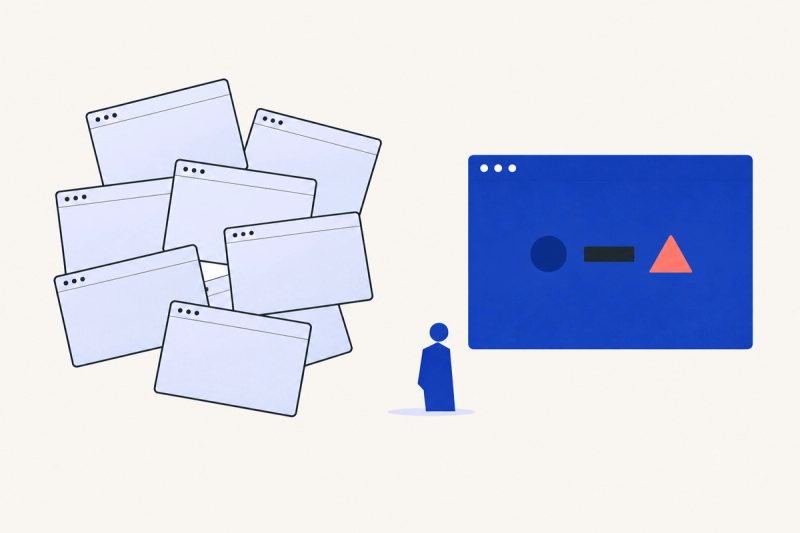
It's 9:04 a.m. You open your ATS. Then your inbox. Then LinkedIn Recruiter, the scheduling tool, the sourcing extension, the spreadsheet your hiring manager still swears by, and a Slack thread titled "quick question."
Seven tabs. You haven't read a single CV yet.
Somewhere in tab four, a finalist has been waiting on feedback for six days. You won't notice until she accepts another offer.
Your recruiting management software was supposed to be the answer. It became tab number seven.
Why recruiting management software keeps turning into one more tab
Aptitude Research asked recruiters how their tech stack actually feels. Only 18% said it supports their workflow smoothly. 61% named poor connectivity between systems as their top frustration. The report's own conclusion was blunt: layering more tools will not improve outcomes.
Recruiters don't need a study to know this. But read it again. We bought systems to manage the work. Now we manage the systems.
The system of record isn't a system of attention
Your ATS knows everything that happened. It was built to remember, not to nudge.
A record answers: "What stage is Maya in?"
You need: "Who is about to slip today?"
Different question. Different screen.
Every tool owns one slice
Scheduling owns interviews. Email owns replies. The ATS owns stages. The spreadsheet owns whatever the hiring manager actually reads.
Nobody owns the whole day.
You do. From memory.
Nine roles, one brain
Picture nine open roles. Senior Backend Java is on day 12. Product Analyst has three finalists and zero feedback. Forty new applications landed overnight for Data Engineer.
Nothing is broken. Everything is drifting.
And every new tool arrives with the same promise: this one will finally unify everything. Then it joins the pile. The integration project takes a quarter. The hiring manager wants a shortlist by Friday.
In that same research, 47% of recruiters described their work as reactive and overloaded. That's what reactive looks like in practice. You don't plan the day. You patrol it, tab by tab.
You're not recruiting at 9 a.m. You're doing tab archaeology: digging through six tools to reconstruct what happened while you slept.
The 9 a.m. Test: three questions, one screen
Before you buy, build, or bolt on anything new, run this test. It works with a Google Sheet, a whiteboard, or the fanciest suite on the market.
At 9 a.m., can you answer three questions in under two minutes, without opening a second tab?
What's new?
Applications, replies, referrals, and sourced profiles since yesterday.
Per role. Not a grand total.
What's stuck?
Candidates sitting in one stage longer than your own rule allows. Pick the rule yourself:
- Feedback: 3 days.
- Scheduling: 5 days.
- Offer reply: 2 days.
Anything past the line becomes visible.
What's about to slip?
The things that cost you a hire if nothing happens today:
- Finalists waiting on a decision.
- Interviews with no feedback.
- Offers with no reply.
If you can answer all three in two minutes, your stack works. If you needed three tabs and a sticky note, it doesn't. It doesn't matter how many features it has.
Two rules that keep the test honest
One screen. Not one login. Seven tools behind a single sign-in is still seven places to look.
Present tense. Not last week's report. A report tells you what happened. The test tells you what to do next.
Run it for five mornings
Write the three questions on a sticky note. Each morning, time yourself. Note which tab you had to open and why.
By Friday you'll have a list of exactly what your stack hides from you. That list is your real buying criteria. Not the feature grid.
The Knoot Angle
A recruiting stack is only as good as the first two minutes of your morning.
That's the idea behind the Activities Dashboard in Knoot. It isn't another system of record, and it isn't a reporting suite. It's the screen you open first: new candidates across all your roles, where each pipeline stands, and what's waiting on you, updating as things happen. The morning-coffee view.
Nothing to dig up. Nothing to hold in your head.
You still decide who moves forward. The dashboard just makes sure nothing slips while you weren't looking.
Fewer tabs. Fewer surprises.
Content
Why recruiting management software keeps turning into one more tab
The system of record isn't a system of attention
Every tool owns one slice
Nine roles, one brain
The 9 a.m. Test: three questions, one screen
What's new?
What's stuck?
What's about to slip?
Two rules that keep the test honest
Run it for five mornings
The Knoot Angle