The More AI Candidates Can See, the Less They Trust You
The more AI candidates can see in your hiring, the less they trust you. The Invisible Line keeps AI in the back office and humans at the front door.

Knoot Admin
August 24, 2026
Content
Why adding AI pushes candidates away
Candidates don't hate AI. They hate meeting it.
"400 people applied, and no one replied to me"
You're automating the most human part
The Invisible Line: put AI where it belongs
Rule 1: AI reads the pile. A human reads the person.
Rule 2: No rejection leaves without a human's name on it
Rule 3: The time AI saves goes back to candidates
The Knoot Angle
You added AI to hiring to look modern, move faster, and lean on fewer people.
But something you're not measuring is moving the other way: candidate trust.
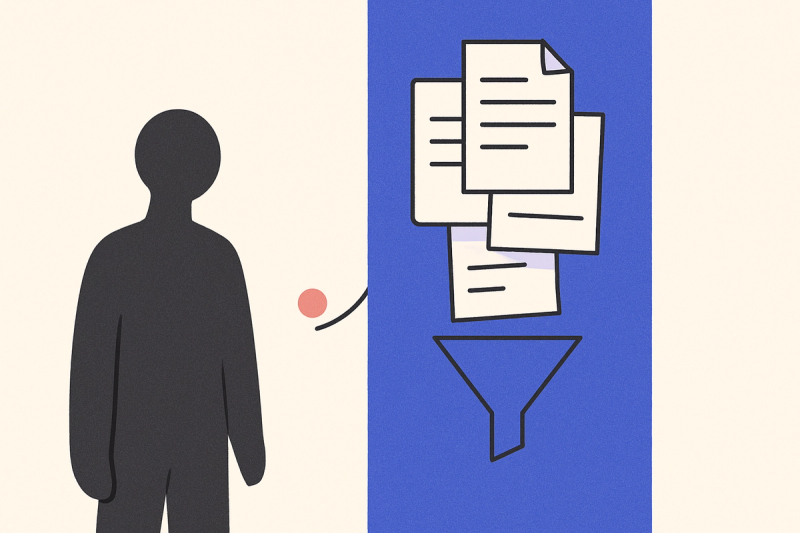
The more AI a candidate can see — the chatbot gating the form, the AI interview through a webcam, the auto-rejection that lands at 2 a.m. — the less they trust you.
Not because the AI is bad. Because they can guess what's behind it: maybe no one actually read them at all.
The problem isn't that you use AI. It's where the candidate sees it.
Why adding AI pushes candidates away
Recruiters think candidates judge a process by speed. They don't.
Candidates judge it by one question: "Is anyone on the other side actually seeing me?"
Candidates don't hate AI. They hate meeting it.
AI scores their CV — they don't mind, because they never see it.
AI answers their message in a machine voice, AI questions them through a screen, AI hits the reject button — that's when trust drops.
Same technology. The difference is where it stands: behind you, or right in front of the candidate.
"400 people applied, and no one replied to me"
One Product Analyst role. 400 applications in 5 days.
You switch on auto-reject for anyone under the match threshold. Clean. Less work.
Except 30 of those 400 were genuinely good — and every one got the same cold, pre-written line, sent at midnight.
They're not angry they got a no. They're angry the no couldn't be bothered to explain itself.
Next time you need them, they remember. Recruiters build a glass wall — you can see each other, but nothing gets through — then wonder why candidates go cold.
You're automating the most human part
The repetitive work should be automated: reading 400 CVs, matching against the JD, ranking fit.
But recruiters keep automating the most human part instead: the rejection, the first reply, the "thanks for applying."
Automate the reading — good. Automate the treatment — you lose.
The Invisible Line: put AI where it belongs
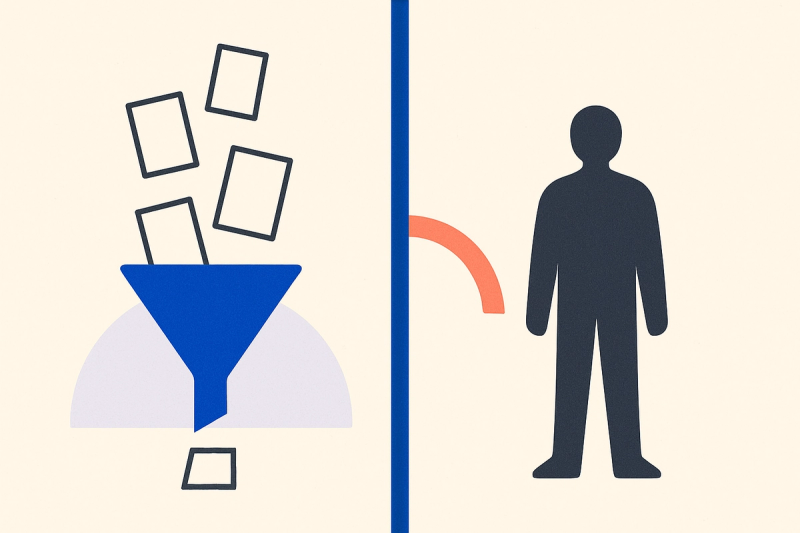
Candidates don't need you to drop the AI. They need to not feel it.
The way there is to draw an invisible line through your process. On one side, the back office — where AI does the heavy lifting. On the other, the front door — where a human always shows up. Three rules keep that line clean:
Rule 1: AI reads the pile. A human reads the person.
AI is allowed to touch the pile — 400 CVs, thousands of lines, the timeline overlaps, the skill claims that don't match the experience.
AI is not allowed to be the first thing a candidate meets. The first touch is always human.
Rule 2: No rejection leaves without a human's name on it
AI can rank someone to the bottom. AI cannot be the name signed under the rejection.
You don't have to hand-write 400 letters. You need one thing: a human looked at the list AI surfaced, and the no goes out under a real name, not "the system."
Candidates forgive a no. They don't forgive a no from nowhere.
Rule 3: The time AI saves goes back to candidates
This is where most recruiters spend it wrong.
AI cuts screening from 3 hours to 15 minutes. What do you do with the 2 hours and 45 minutes?
If the answer is "take on 5 more reqs," you've just turned AI into a volume pump — and candidates still hear from no one.
Give that time back to people: a real call, real feedback, one message that wasn't written in advance. That's where trust comes back.
The Knoot Angle
In the end, candidates aren't afraid of AI in hiring. They're afraid no one is accountable for the decision made about them.
A good tool doesn't push people out of the doorway. It clears the work a machine does cleaner, so a human can stand where a human needs to stand. That's why AI Screening in Knoot is built to sit in the back office — not at the front door.
- It flags, it doesn't auto-reject. AI compares each profile against your JD criteria, ranks the match, and points out risks — overlapping timelines, skill claims that don't match — but the final call is always yours.
- Every shortlist comes with a reason. AI explains why each candidate was surfaced, so you keep or cut them on evidence, not on a black-box verdict.
- It runs on the pile, not on the person. AI works the volume so you have time to work the humans.
Let AI handle the pile. You handle the person.
Content
Why adding AI pushes candidates away
Candidates don't hate AI. They hate meeting it.
"400 people applied, and no one replied to me"
You're automating the most human part
The Invisible Line: put AI where it belongs
Rule 1: AI reads the pile. A human reads the person.
Rule 2: No rejection leaves without a human's name on it
Rule 3: The time AI saves goes back to candidates
The Knoot Angle