Why Recruiters Spend 2 Hours Sourcing… But AI Does It in 2 Seconds
A sharp breakdown of why recruiters spend hours sourcing while AI does it in seconds — exposing hidden bottlenecks and showing how to speed up the entire sourcing workflow.

Jack
November 30, 2025
Content
The uncomfortable truth every recruiter already knows
The painful 2-hour sourcing loop we pretend is normal
Data is scattered everywhere
JD expectations vs. market reality
Most of your effort is spent eliminating
You rely on memory more than you think
The “double-check instinct”
Two real TA scenarios that every recruiter nods at
Senior Java Developer sourcing
The vague role – Product Analyst
Why AI handles the same workload in 2 seconds
AI reads JDs like a semantic analyst
AI searches your entire talent universe at once
AI eliminates mismatches instantly
AI scores match % so you don’t rely on “gut feeling”
AI finds hidden candidates humans miss
AI frees recruiters to do high-impact work
The ‘2S + 2F’ Framework to Source Faster (with or without AI)
Simplify the JD (S)
Standardize your search (S)
Focus on high-value activities (F)
The Knoot Angle
The uncomfortable truth every recruiter already knows
If you’re a recruiter, you’ve lived this moment:
You open your laptop, take your first sip of coffee, and suddenly…
“Hey, can you get me a shortlist of 5 Senior Backend Java by EOD?”
Your soul leaves your body for a second.
Tabs fly open. LinkedIn, job boards, Gmail, ATS, Sheets.
Two hours later, you finally have something decent enough to show.
Meanwhile, an AI sourcing engine does the same work in seconds—analyzing the JD, scanning your entire talent pool, interpreting hidden skills, removing mismatches, and handing you a shortlist like:
“Here are 12 candidates with 87%+ match. Your hiring manager will be pleased.”
So… why the massive speed difference?
The painful 2-hour sourcing loop we pretend is normal

Recruiters aren’t slow.
Recruiters are overloaded.
Here’s what actually slows you down—daily:
Data is scattered everywhere
LinkedIn, job boards, inbox, referrals, your ATS, your Excel graveyard.
You’re not slow—you’re multiverse-sourcing.
JD expectations vs. market reality
The JD lists 20 skills.
You know only 10 actually matter.
But figuring out those 10 costs time and sanity.
Most of your effort is spent eliminating
- Wrong salary.
- Wrong location.
- Wrong tech stack.
- Wrong seniority.
Looks great on paper but absolutely not relevant.
Recruiters reject more than they source.
You rely on memory more than you think
- Who applied last time?
- Who said they weren’t open?
- Who ghosted?
- Who almost passed?
ATS rarely tells the full story. Your brain does the heavy lifting.
The “double-check instinct”
You don’t want a shortlist that’s “okay.”
You want a shortlist that will survive a hiring manager interrogation.
That extra polish = extra time.
The result:
→ 2 hours sourcing = normal
→ 3 hours = also normal
→ You = always behind
Two real TA scenarios that every recruiter nods at
Senior Java Developer sourcing
You must:
- Open JD
- Break down must-have vs. nice-to-have
- Search multiple job boards
- Try 5–7 keyword variations
- Filter 40 profiles
- Remove overqualified & underqualified candidates
- Review each LinkedIn profile manually
- Add notes to your sheet
- Repeat until you have 5 “safe” names
Time: 1.5–2 hours
Output: 5 candidates barely enough to defend in a weekly sync.
The vague role – Product Analyst
Job titles are inconsistent across companies.
You have to guess:
- Could a BA fit?
- Could a Data Analyst transition?
- Is a Product Owner too senior?
- How transferable is their domain knowledge?
Time: ~2 hours just to understand the market landscape.
Why AI handles the same workload in 2 seconds
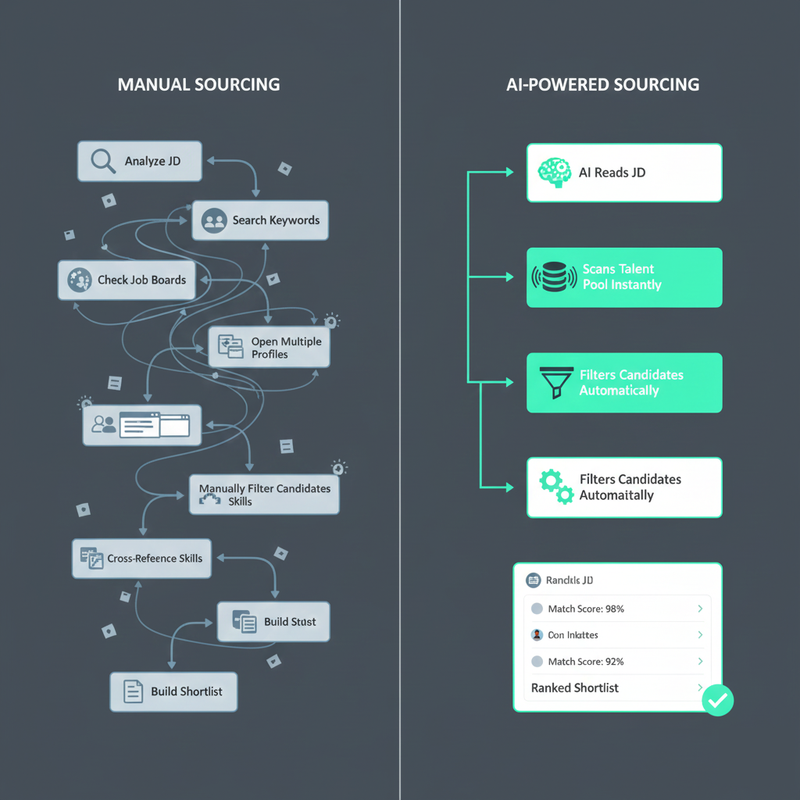
AI isn’t smarter than recruiters.
AI is simply not human, which means:
- No fatigue.
- No context switching.
- No limitations in data processing.
Here’s the breakdown:
AI reads JDs like a semantic analyst
Recruiters analyze JDs with experience.
AI analyzes with:
- Semantic mapping
- Skill clustering
- Keyword expansion
- Industry pattern recognition
AI knows “Java = Spring Boot = OOP = Microservices ecosystem” even if the JD forgets to mention any of it.
2 seconds: JD fully understood.
AI searches your entire talent universe at once
You open 4 tabs.
AI scans thousands of CVs, previous applicants, your talent pool, and title variations simultaneously.
- Zero duplicates.
- Zero missed candidates.
- Zero wasted time.
AI eliminates mismatches instantly
AI checks:
- Location
- Level
- Tech stack
- Stability signals
- Domain familiarity
- Cultural patterns
What takes you 10 minutes per candidate takes AI milliseconds.
AI scores match % so you don’t rely on “gut feeling”
Recruiters often shortlist by intuition.
AI quantifies match by:
- Skill relevance
- Experience depth
- Domain similarity
- Additional signals
The output becomes a Match Score.
This ends debates with hiring managers before they start.
AI finds hidden candidates humans miss
Humans search by keyword.
AI searches by meaning.
Example:
CV says “built high-traffic microservices,” but never mentions “Spring Boot.” Recruiters won’t find them. AI will.
AI frees recruiters to do high-impact work
You gain back your 2 hours/day.
Instead of drowning in CVs, you can:
- Talk to candidates
- Assess real fit
- Build trust
- Close faster
AI doesn’t replace recruiters.
AI removes the parts that slow recruiters down.
The ‘2S + 2F’ Framework to Source Faster (with or without AI)
A practical system recruiters can use immediately:
Simplify the JD (S)
Reduce the JD into:
- Top 5 core skills
- 3 must-have requirements
- 2 culture factors
Trim the fantasy list.
Standardize your search (S)
Prepare:
- Keyword packs
- Boolean templates
- Title variations
- Competitor lists
Your future self will thank you.
Filter fast (F)
Reject first, shortlist later.
Location mismatch? Out.
Salary mismatch? Out.
Level mismatch? Out.
Speed comes from quick elimination.
Focus on high-value activities (F)
Less time sourcing.
More time assessing and closing.
Recruiters grow by improving judgment, not filtering.
The Knoot Angle
At the end of the day, speed in recruitment isn’t a luxury — it’s survival.
Great recruiters don’t waste hours on the parts of sourcing that a machine can do faster and cleaner. They save their energy for the work only humans can do: understanding motivations, managing expectations, and closing the right person for the right role.
That’s exactly why tools like Knoot exist.
Knoot’s Quick Search module sits at the heart of this idea.
You drop in a few keywords — job title, skill, tech stack, anything — and the system sweeps through thousands of candidate profiles instantly. It doesn’t just match literal keywords; it scans semantic variations, related skills, synonyms, and role clusters to find people you would likely miss when sourcing manually.
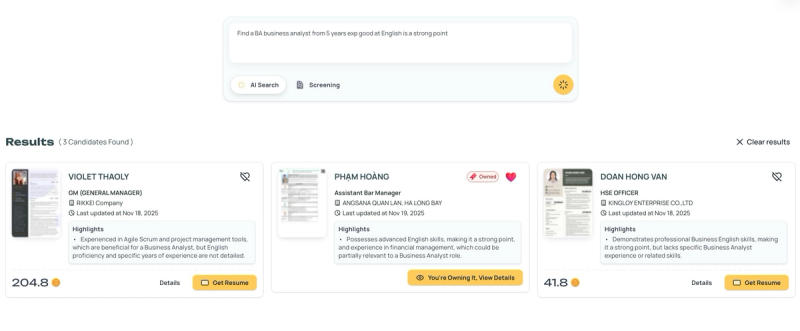
The result?
You get a clean, high-quality shortlist in seconds, not hours.
No fluff, no repetitive scrolling, no second-guessing.
It’s not about replacing recruiters.
It’s about eliminating the slow, mechanical parts of the job so you can be the version of yourself your team actually needs — fast, sharp, and focused on decisions, not data cleanup.
Let AI handle the 2 seconds.
You take care of the rest — the human part, the strategic part, the part no machine can replicate.
Content
The uncomfortable truth every recruiter already knows
The painful 2-hour sourcing loop we pretend is normal
Data is scattered everywhere
JD expectations vs. market reality
Most of your effort is spent eliminating
You rely on memory more than you think
The “double-check instinct”
Two real TA scenarios that every recruiter nods at
Senior Java Developer sourcing
The vague role – Product Analyst
Why AI handles the same workload in 2 seconds
AI reads JDs like a semantic analyst
AI searches your entire talent universe at once
AI eliminates mismatches instantly
AI scores match % so you don’t rely on “gut feeling”
AI finds hidden candidates humans miss
AI frees recruiters to do high-impact work
The ‘2S + 2F’ Framework to Source Faster (with or without AI)
Simplify the JD (S)
Standardize your search (S)
Focus on high-value activities (F)
The Knoot Angle