CV Screening Criteria: Set Them Before 300 Applications
300 applications per role and every CV reads the same. Here's the 3 Locks method to set your CV screening criteria before the flood arrives.

Knoot Admin
August 07, 2026
Content
Why reading more CVs doesn't make you pick better
CV monoculture
Your bar drifts by the hour
You filter on whatever is fastest to see
You and the hiring manager never agreed on “qualified”
The “3 Locks” method: lock your CV screening criteria before the flood
Lock 1 — Lock the floor
Lock 2 — Lock the weights
Lock 3 — Lock the proof
The Knoot Angle
Every recruiter has noticed it. Almost nobody says it out loud: the CV has stopped working as a filter.
You post a Senior Backend Java role. Four days later, 280 applications.
You open the first one. Clean formatting, a tidy three-line summary, strong verbs.
You open the second. Clean formatting. Tidy three-line summary. The same strong verbs.
By number thirty, you can't tell them apart.
That's not because candidates got weaker. It's because they all share the same writing assistant.
Your problem was never 280 applications. Your problem is that you're still deciding what “qualified” means somewhere around application 187.

Why reading more CVs doesn't make you pick better
CV monoculture
Same prompt in, same CV out.
- Same layout.
- Same summary.
- Same verbs.
- Same length.
You're not reading 280 people. You're reading 280 copies of one seed.
Your bar drifts by the hour
The recruiter at application 12 and the recruiter at application 187 aren't the same judge.
At 9am you're strict. At 4pm you're generous.
Same CV, two different sittings, two different verdicts.
Nothing in your process measures that drift. Not even you.
You filter on whatever is fastest to see
Company names. School names. Years of experience.
They scan fastest, so you scan them first.
They're also the three things an AI-polished CV dresses up best.
You and the hiring manager never agreed on “qualified”
You send 8 profiles. The hiring manager rejects 7 — “not quite it.”
You ask what “it” means. The answer: “send a few more and I'll know.”
The loop restarts, with 280 applications still sitting there.
The result:
280 applications = normal
400 = also going to be normal
You = still deciding by feel at 4pm
More applications don't make you a better judge. They just make you tired earlier.
The “3 Locks” method: lock your CV screening criteria before the flood
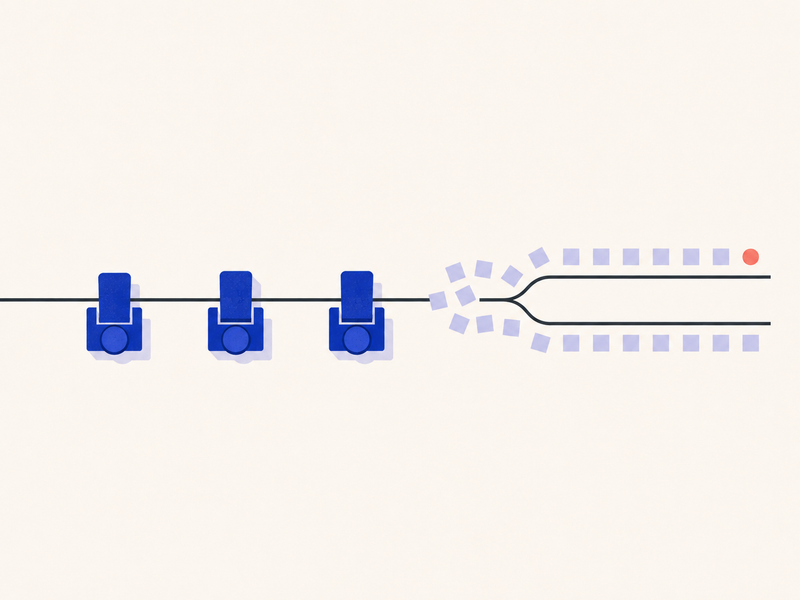
Your filter has to live outside your head, and it has to exist before the first application lands.
Lock it once. Use it on all 280.
Lock 1 — Lock the floor
Before you open a single CV, write down 3–4 conditions where a miss ends the review.
- Work location.
- Budget ceiling.
- Years in a comparable role.
- One core skill with no substitute.
A floor isn't a wish list. A floor is what you're willing to defend to the hiring manager.
If you wouldn't defend it, it isn't a floor.
Lock 2 — Lock the weights
Not every requirement carries the same load. But while you're reading, your brain treats them like they do.
Put numbers on it:
- Core skill: 40%
- Domain experience: 25%
- Scale they've operated at: 20%
- Everything else: 15%
Thirty seconds here saves three hours of debate later.
A 70% match in the right places beats an 85% match in the wrong ones.
Lock 3 — Lock the proof
For each criterion, decide up front what actually counts as evidence.
- “Experienced with Kubernetes” → doesn't count.
- “Ran a 40-node cluster, cut downtime from 6 hours to 40 minutes” → counts.
Then every CV gets one question: is there a number, a scope, a consequence?
This is also where AI-written CVs give themselves away fastest. AI writes fluent description. It can't manufacture scope a candidate never touched — and if it tries, you now have a very specific thing to ask in the interview.
You can run all three locks in a single Google Sheet.
The hard part isn't the tool. The hard part is locking anything before the applications arrive.
The Knoot Angle
When every application is equally polished, your edge isn't reading faster. It's knowing exactly what you're looking for before the first CV shows up.
That's why Knoot puts the criteria step at job creation, not at CV review. In the Job Management module, every role you open carries its own scoring criteria instead of one template stretched across every opening. Because the criteria are locked up front, application 1 and application 280 get measured with the same ruler — whether you're reading at 9am or 4pm. The full application flow for each role sits in one view, so you can see which position is stuck and where it's stuck.
The criteria stay yours: edit them whenever you want, and the call on who makes the shortlist is still yours to make.
Stop filtering CVs from memory. Filter with the bar you already set.
Content
Why reading more CVs doesn't make you pick better
CV monoculture
Your bar drifts by the hour
You filter on whatever is fastest to see
You and the hiring manager never agreed on “qualified”
The “3 Locks” method: lock your CV screening criteria before the flood
Lock 1 — Lock the floor
Lock 2 — Lock the weights
Lock 3 — Lock the proof
The Knoot Angle