Your Outreach Isn't Bad. It's Just Not Different Anymore.
Reply rates keep dropping no matter how you rewrite it? The Warmth Ladder shows why recruiter cold outreach fails and what to change instead.

Knoot Admin
August 17, 2026
Content
Why polishing your outreach keeps making it worse
You're not landing in an inbox. You're dropping into a full pool.
Candidates aren't lazy. They're defending themselves.
Three seconds, and nothing to prove you're worth them
The Warmth Ladder: change the source, not the script
Rung 1 — Cold
Rung 2 — Warm
Rung 3 — Vouched
The fifteen-minute audit
The Knoot Angle
You rewrite the opening line for the fourth time. Swap "Hi there" for their first name. Add a sentence about the repo they pushed last week. Send.
Nothing.
Here's the part nobody says out loud: your message isn't bad. It just isn't different anymore.
Five years ago, a personalized message proved you'd done the homework. Today AI writes two hundred of them before lunch — and the engineers you want receive all two hundred every month.
Personalization stopped being a signal. It turned into noise.
So if the problem isn't the copy, where is it?
Why polishing your outreach keeps making it worse
Because you're optimizing the right thing in the wrong place.
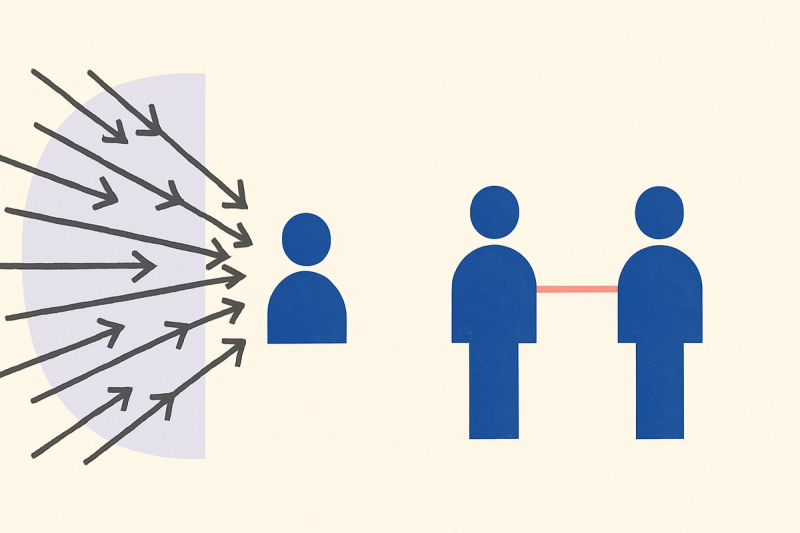
You're not landing in an inbox. You're dropping into a full pool.
There are maybe a few hundred Senior Backend Java engineers with five years of experience in Ho Chi Minh City.
Forty recruiters run the same LinkedIn filter. The same ITviec keyword. The same competitor list.
That engineer never reads your message. They scroll past forty near-identical ones and close the app.
And the tell is always the same. Every one of those messages opens by describing something the candidate already knows about themselves, then asks for twenty minutes.
Good copy = ignored
Bad copy = ignored
You = indistinguishable
Candidates aren't lazy. They're defending themselves.
They used to reply. Then came the salary that didn't match. Then the silence after round two. Then a copy-pasted JD for a job they outgrew four years ago.
Not replying is the cheapest way to protect their time. Silence costs them nothing and screens out almost everything. From where they sit, it's a rational policy, not rudeness.
The strong ones learned this earliest. Which is exactly why the people you most want to reach are the least likely to answer a stranger.
Three seconds, and nothing to prove you're worth them
To a stranger you get exactly three things: a company name, a logo, a subject line.
If your employer brand is still small, you get two.
Meanwhile the recruiter who placed that engineer's former teammate last quarter needs none of it. She gets a reply in eleven minutes, and her message was four lines long with a typo in it.
Everyone is sharpening the message. Almost nobody changes the source.
Wrong lever.

The Warmth Ladder: change the source, not the script
Reply rate isn't a measure of your writing. It's a measure of distance.
Close the distance and mediocre copy still gets answered. Keep the distance and great copy still sinks.
Three rungs, ordered by distance:
Rung 1 — Cold
People who've never heard your name.
- No context.
- No reason to trust.
- Lowest reply rate.
You'll always need some of it. You just shouldn't live there.
Rung 2 — Warm
People who've already brushed against you:
- Applied, lost to headcount.
- Interviewed, chose elsewhere.
- Commented on your post.
- Showed up at your event.
They already know who you are. Your opening line doesn't have to sell. It only has to remind.
Most of this group is already sitting in your talent pool. You just never open it.
Rung 3 — Vouched
People handed to you by another recruiter who has actually spoken with them.
You don't start at zero. You start where somebody else already did the hard part: confirming this person is real, currently open, and roughly at the level you need.
This is the rung most recruiters leave empty. Not because they don't want it, but because there's rarely a clean, fair place to do it.
The fifteen-minute audit
Open your most recent shortlist. Next to each name write one word: Cold, Warm, or Vouched.
If more than 80% reads Cold, you don't have a copywriting problem. You have a sourcing problem.
Do it again in a month and you'll see the ratio move before your reply rate does. That's the correct order — the numbers follow the source, not the other way around.
Next week, move one person from Cold to Warm. One is enough.
The Knoot Angle
Recruiting was never a contest for who writes the best message. It's a contest for who already has the relationship when the req drops.
The catch is that Rung 3 is nearly impossible to build alone. You need other recruiters — and a fair set of rules so nobody feels they're giving more than they get back.
Knoot's Talent Community was built for exactly that gap:
- Profiles arrive with context: an AI-built summary plus feedback from recruiters who've already talked to them, before you decide to unlock.
- Exchange with rules: share the CVs you can't use to earn points, spend points on the ones you need. No favors, no awkward asking.
- Privacy holds: the original CV and personal details stay hidden until unlock.
- Points keep coming back: every time someone unlocks a profile you shared, more points return to you.
Recruitment is a collaboration between people. Knoot just makes that collaboration possible at scale.
Stop polishing what you say to strangers. Start having fewer strangers to talk to.
Content
Why polishing your outreach keeps making it worse
You're not landing in an inbox. You're dropping into a full pool.
Candidates aren't lazy. They're defending themselves.
Three seconds, and nothing to prove you're worth them
The Warmth Ladder: change the source, not the script
Rung 1 — Cold
Rung 2 — Warm
Rung 3 — Vouched
The fifteen-minute audit
The Knoot Angle