Hiring Budgets Are Shrinking. Your Candidate Database Is the Asset Nobody Manages.
Candidate database management software only works if every record has an owner, a reason and a next touch. Try the 3-Field Rule in a Google Sheet first.

Knoot Admin
November 05, 2026
Content
Why every candidate database turns into a CV landfill
Records with no owner
Records with no reason
Records with no next step
Records you can't find
The 3-Field Rule: manage candidate data like a pipeline
Field 1: Owner
Field 2: Reason
Field 3: Next touch
The Friday 20
Don't fix all 1,400 at once
The Knoot Angle
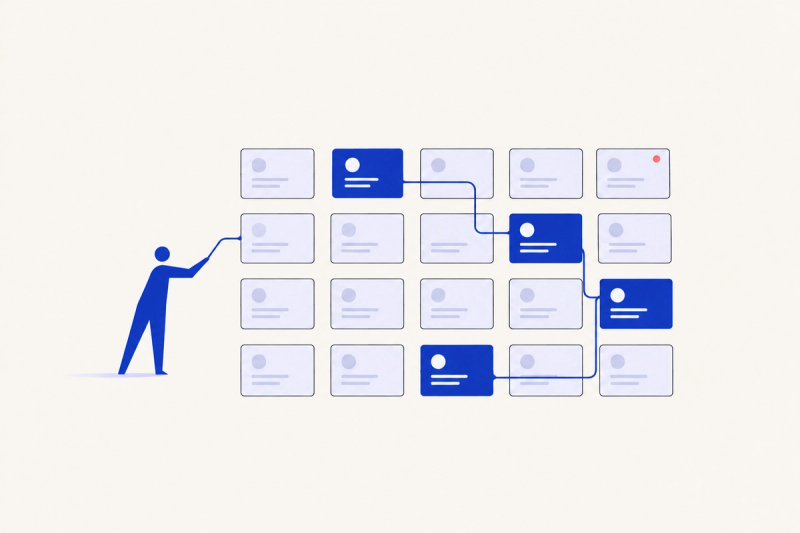
It's Monday, 8:40 a.m. Your hiring manager wants five Senior Backend Java profiles by Thursday. The sourcing budget for the quarter is already gone.
So you do what every recruiter does. You open LinkedIn. Forty minutes later you have three people who look fine.
Meanwhile, 1,400 candidates you already screened, interviewed, or shortlisted sit in a folder called "CVs_FINAL_v3." You haven't opened it since June.
Your cheapest sourcing channel is the one you already paid for. And nobody manages it.
Why every candidate database turns into a CV landfill
Employ's Recruiter Nation 2026 survey of 1,200+ US recruiters and HR managers found that only 60% expect more hires in the next year, down from 70% in 2025. Just 51% expect recruiting budgets to rise, down from 67%. And isolved's 2026 HR Leaders Report, covering 1,005 US HR decision-makers, found that 60% say their recruiting strategies fall short on speed.
Less money. Same pressure to move fast.
The cheapest candidate you can reach is one you've already met. So why can't you reach them?
Records with no owner
Three recruiters left in two years. Each one left behind a spreadsheet, or took it with them, which is cleaner but worse.
Nobody knows who spoke to Priya in March. So nobody calls her.
She builds payment APIs at a fintech. She told your former colleague she'd consider a move after her September bonus. That sentence exists in no system you own. It left the building with the person who heard it.
Records with no reason
A name. A CV. A date.
Why did you keep her? Strong on payments? Wrong salary band? Great, but not ready to move?
The reason lived in your head. Your head has moved on to nine other roles.
Records with no next step
"Keep in touch" is not a plan.
Nobody sets the date, so the date never comes. By month eight the phone number is dead and the job title is two promotions old.
Records you can't find
Search "Java" and you get 600 results. Search "Java payments Berlin" and you get zero, because half the files are scanned PDFs and the other half are called resume.pdf.
A record you can't find is a record you don't have.
You don't have a candidate database. You have a CV landfill with a search bar.

The 3-Field Rule: manage candidate data like a pipeline
Before you buy any candidate database management software, run this in a Google Sheet. Software only speeds up a habit. It can't create one.
Every record gets three fields. No field, no entry.
Why only three? Because the fourth field is where the habit dies. Ten fields means nobody fills them in. Three takes under a minute per record, and they answer the only questions that matter on a Monday morning: who knows her, why do we care, and when do we call.
Field 1: Owner
One named recruiter per record. Not "team." Not "shared."
The owner is the person who answers for it when the candidate goes cold.
Ownership also settles the hardest question in any team. When a recruiter leaves, their records transfer by name, not by accident.
Field 2: Reason
One line. Why did you keep this person?
- "Strong Go, left on salary."
- "Great PM, wrong timing."
- "Final round, lost to an internal hire."
Five to ten words. Written the day you decide, not six months later.
Field 3: Next touch
A real date. Not "soon."
- Hot: 30 days.
- Warm: 90 days.
- Cold: 180 days, then a decision. Touch or retire.
Retiring is not failure. A record nobody will ever touch is noise, and noise buries the records that matter.
The Friday 20
Every Friday, sort by next touch and clear twenty records. Send the message. Update the date. Twenty minutes.
Fifty Fridays later you've reopened a thousand conversations.
Don't fix all 1,400 at once
Start with the top 100: the roles you hire for most, the seniority you struggle to find. Write the owner, the reason, and the next touch. Retire anything you can't justify keeping.
One afternoon. A pool you can actually use on Monday.
And when the next role lands, you search your own people first. Before LinkedIn. Before the job board. Before the budget request.
The Knoot Angle
Good sourcing isn't always finding new people. Sometimes it's remembering who you already know.
The 3-Field Rule works in a spreadsheet. The painful part is the setup: retyping a thousand CVs into rows before your first Friday. That's the part Private Talent Pool in Knoot is built to remove. You upload CVs up to 50 at a time, and they're parsed and structured in under five minutes. No retyping. When a role opens, you search your own people by keyword and filter before you open a single job board.
It's yours. Your candidates, your notes, your call on who gets the message. Knoot just makes sure every search starts with the people you've already earned.
Stop renting candidates. Start owning them.
Content
Why every candidate database turns into a CV landfill
Records with no owner
Records with no reason
Records with no next step
Records you can't find
The 3-Field Rule: manage candidate data like a pipeline
Field 1: Owner
Field 2: Reason
Field 3: Next touch
The Friday 20
Don't fix all 1,400 at once
The Knoot Angle