Every Resume Sounds Like a Promotion Now. Your AI Resume Screening Tool Is Grading the Costume.
An AI resume screening tool can't tell polished from proven. Use the 3C Test (Claim, Cost, Check) to screen for evidence when every resume looks perfect.

Knoot Admin
October 30, 2026
Content
Why does your AI resume screening tool still reward the wrong thing?
Polish used to cost something
Keyword match grades the costume
The pile lies in unison
You become the lie detector
The 3C Test: screen for proof, not polish
Claim: shrink it to one sentence
Cost: what did it cost them?
Check: can it survive ten minutes?
The Knoot Angle
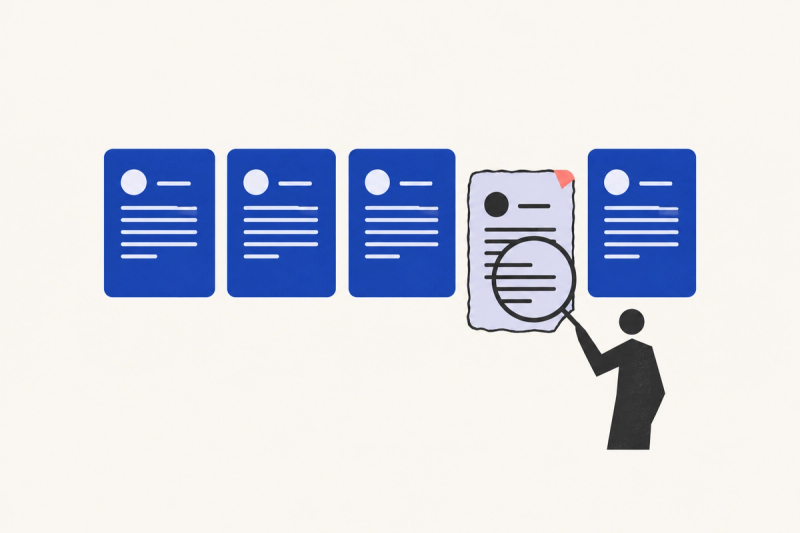
Tuesday, 8:40 a.m. Your inbox holds 412 applications for the Senior Backend Engineer role. They landed since Friday.
You open twenty. Every one reads like a promotion memo. "Architected scalable microservices." "Drove cross-functional alignment." "Significantly improved performance."
Same verbs. Same rhythm. Same confidence.
Employ's latest Recruiter Nation report ranks AI-polished resumes as recruiters' top stressor, the first time AI has topped that list.
Volume you can handle. This is something else.
When every resume is polished, polish stops being a signal. So what are you actually screening for?
Why does your AI resume screening tool still reward the wrong thing?
You bought software to read faster. It reads faster. It just reads the wrong layer.
Polish used to cost something
A clean resume once meant effort. Someone cared enough to edit.
Now it costs thirty seconds and a prompt.
Fluent = free. Free = everywhere. Everywhere = no information.
Think of the last "strong" resume you phoned. How often did the call match the page? If the honest answer is "about half", the page was never the evidence.
Keyword match grades the costume
Your filter sees "Kafka, Kubernetes, led a team of 8" and scores the sentence. It can't tell who lived it and who had it suggested.
Polish is a costume. A tool that grades costumes shortlists the best-dressed.
The pile lies in unison
Ask yourself how many of the 412 would survive one follow-up question. Nobody knows, because every resume answers in the same smooth voice.
When all the answers sound right, "sounds right" is worthless.
You become the lie detector
By resume 60, you stop reading. You pattern-match. Fast, tired, wrong.
Your best candidate wrote plainly: "Moved billing from cron jobs to queue workers. Retries dropped from 30 a day to 2."
Next to the polished ones, it looks dull.
- Plain wording.
- Real numbers.
- Rejected in four seconds.
The 3C Test: screen for proof, not polish
It works with a spreadsheet. Take each shortlisted candidate's top three claims and run three questions on them. Ten minutes per candidate, tops, and only for people already on the shortlist, never for the full pile.
Claim: shrink it to one sentence
Strip the adjectives. "Led migration of billing to queue workers."
If nothing is left under the polish, there was never a claim. That alone clears a surprising share of the pile.
Cost: what did it cost them?
Real work leaves scars. A constraint. A trade-off. A number with a before and after. Something that broke first.
AI polish gives you outcomes with no cost: "significantly improved performance."
Real claim = outcome + constraint + trade-off.
Check: can it survive ten minutes?
Pick one claim per candidate. Ask one open question on the screening call: "What failed in week two?"
Someone who did the work answers in specifics. Someone who didn't answers in adjectives.
Here's how it plays out on two candidates for the same role.
Candidate A: "Drove significant performance gains across the platform." Claim: unclear. Cost: none. Check: a vague answer about "the team".
Candidate B: "Moved billing to queue workers. Retries fell from 30 a day to 2." Claim: clear. Cost: a rewrite of retry logic. Check: tells you about the week-two failure unprompted.
B was the plain one. B goes to the top.
Tag every claim in your sheet: Proven, Plausible, or Polished. Polished claims move down the list. Nobody gets deleted on a hunch.
The Knoot Angle
AI doesn't decide who gets hired. AI just makes sure no good candidate gets lost in the noise.
The step of 3C that breaks at 412 applications is Cost. Nobody has time to hunt for scars in that many resumes. That's the job for an AI tool for resume screening, and it's where Knoot AI Screening fits. It compares every candidate against the criteria from your job description and returns a ranked shortlist, with match % and a written reason for each name. It flags what deserves a second look: skill claims that don't match experience, timeline overlaps, exaggerations. Flags, not rejections. You make the call.
AI flags the polish. You find the proof.
Content
Why does your AI resume screening tool still reward the wrong thing?
Polish used to cost something
Keyword match grades the costume
The pile lies in unison
You become the lie detector
The 3C Test: screen for proof, not polish
Claim: shrink it to one sentence
Cost: what did it cost them?
Check: can it survive ten minutes?
The Knoot Angle