Your AI Screener Rejected a Great Candidate. Run It Again, It Hires Them.
Run the same AI resume screening twice and you get two different shortlists. Here is why it happens, and a 3-C test to make screening you can trust.

Knoot Admin
September 08, 2026
Content
Why the same AI screener gives you two shortlists
It's reading the resume, not the criteria
Same input, different output
You can't see the reason
The person who pays is your best candidate
The 3-C Test: how to trust a shortlist again
C1 — Criteria: score against a list, not a vibe
C2 — Consistency: run it twice, demand the same answer
C3 — Cause: every verdict comes with a reason
The Knoot Angle
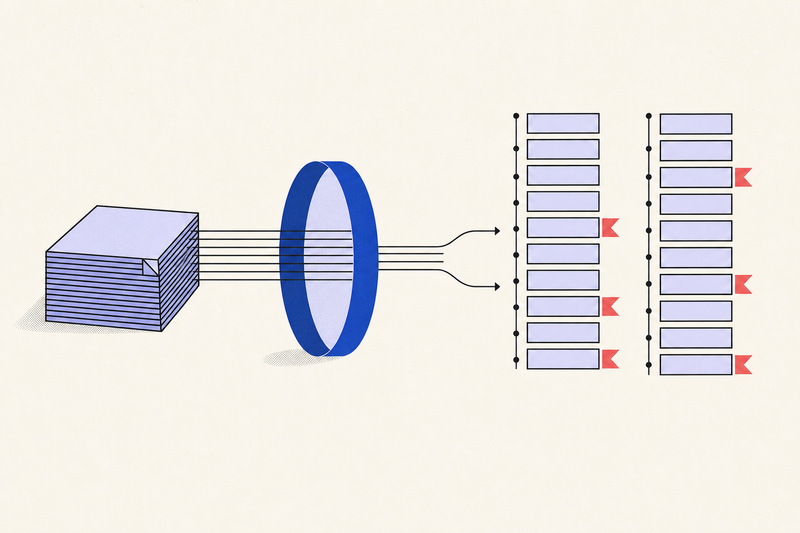
You drop 200 resumes into your AI screener. It hands back a top 10. You trust the list.
Now try something almost no recruiter does: run it again. Same 200 resumes. Same JD. Nothing changed.
The second top 10 isn't the first one.
Not off by a slot or two. Sometimes it overlaps by one or two names. A candidate the tool cut at 9am makes the shortlist at 2pm. And the other way around.
If a filter gives you different answers on identical data, it isn't a filter. It's a slot machine with a confident voice.
Why the same AI screener gives you two shortlists
The problem isn't that the AI is dumb. It's that most tools are guessing, not scoring.
It's reading the resume, not the criteria
Most screeners take in raw resume text plus a vague prompt — "find the best fit."
No must-haves. No weights. No definition of "fit."
So every run, the model re-decides what good looks like. And that decision drifts.
Same input, different output
You're hiring a Senior Backend Java engineer. Same 200 profiles.
First run, a candidate with six years of Spring Boot lands at rank 4. Second run, same person drops out of the top 10, edged out by a strong Node resume.
You changed nothing. The model just re-rolled the dice.
Rejected at 9. Shortlisted at 2. Same resume.
You can't see the reason
The tool returns "87% match." Where the 87 comes from, nobody can tell you.
A number with no reason behind it is a number you can't check. And a verdict you can't check has no business deciding who gets a callback and who doesn't.
The person who pays is your best candidate
Here's the part that should bother you.
The candidates who fall through this randomness aren't the obvious mismatches — those get cut every run. It's the strong-but-nonstandard ones. The self-taught engineer. The career-switcher. The person whose experience needs a second read.
They're exactly the profiles a drifting model scores differently each time. So the more interesting the candidate, the more likely they vanish on the run you happened to trust.
You didn't reject them. A dice roll did. And you never saw it happen.
The 3-C Test: how to trust a shortlist again
This isn't a tool hack. It's how to judge any screening process — even one you run with a spreadsheet and a criteria checklist.
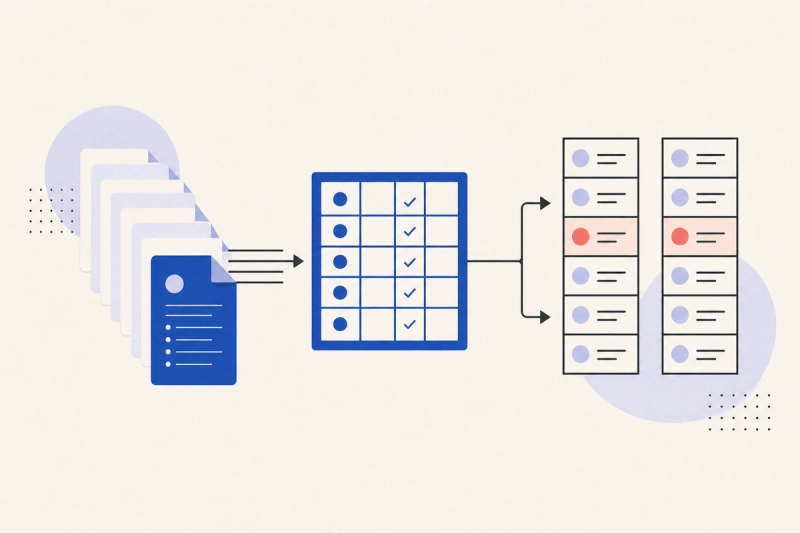
Three C's: Criteria, Consistency, Cause.
C1 — Criteria: score against a list, not a vibe
Before you screen, break the JD into an explicit set:
- Must-have
- Nice-to-have
- Bonus
Give each a weight. Now the AI has something to check against, instead of inventing "fit" fresh every time.
Ten minutes on the criteria kills most of the drift before you screen a single resume. It's the least glamorous step and the one everyone skips.
C2 — Consistency: run it twice, demand the same answer
Cheapest test you'll ever run, and the most revealing.
Screen the same batch twice. If the shortlists don't match, don't trust it — no matter how clean the match score looks.
Same input has to give the same output. That's the line between scoring and gambling.
You don't need special software to do this. Two runs, side by side, count the overlap. If eight of ten names hold, you have a tool. If two hold, you have a slot machine — and now you know.
C3 — Cause: every verdict comes with a reason
For each shortlisted candidate, ask one question: why?
Matched on which must-have? Cut for missing what? If the tool can't answer, it isn't screening for you — it's hiding its decision behind a number.
Good screening isn't the fastest screening. It's the screening you can explain to a hiring manager without saying "the AI just said so."
Run the three in order and something quietly changes: you stop outsourcing judgment to a black box and start using AI the way it actually helps — as a tireless first pass over criteria you defined, that you can audit line by line.
The Knoot Angle
Screening speed is only worth something if you can trust what comes out. A shortlist that lands in two seconds but changes every run doesn't save time — it just moves the risk somewhere you can't see it.
That's why Knoot's AI Screening doesn't score resumes blind. It checks each profile against a criteria set pulled straight from your JD, so the result tracks what you actually need — not whatever the model felt like that run.
- A ranked match %, with the reasoning attached to each shortlisted candidate.
- Risk flags: overlapping timelines, skill claims that outrun the experience.
- And the part that matters most: the AI flags and surfaces — it never rejects anyone. You still make the call.
A shortlist is only worth trusting when you can walk back every line of reasoning behind it.
Let AI make sure nothing slips. You make the decision.
Content
Why the same AI screener gives you two shortlists
It's reading the resume, not the criteria
Same input, different output
You can't see the reason
The person who pays is your best candidate
The 3-C Test: how to trust a shortlist again
C1 — Criteria: score against a list, not a vibe
C2 — Consistency: run it twice, demand the same answer
C3 — Cause: every verdict comes with a reason
The Knoot Angle