Your AI Recruiting Agent Works the Night Shift. Nobody Wrote the Handoff Note.
Dayforce is buying an AI interviewer. But an AI recruiting agent that works nights creates a morning problem. Try the 3-Pile Morning to stay in control.

Knoot Admin
October 28, 2026
Content
Why every AI recruiting agent creates a morning nobody planned for
The night shift leaves no handoff note
A flag without an owner is just noise
Nobody can see the whole board
More throughput, more loose ends
The 3-Pile Morning: how to run an AI recruiting agent without losing the plot
Pile 1: Done
Pile 2: Stuck
Pile 3: Yours
Give every pile a clock
Why this works with or without an agent
The Knoot Angle
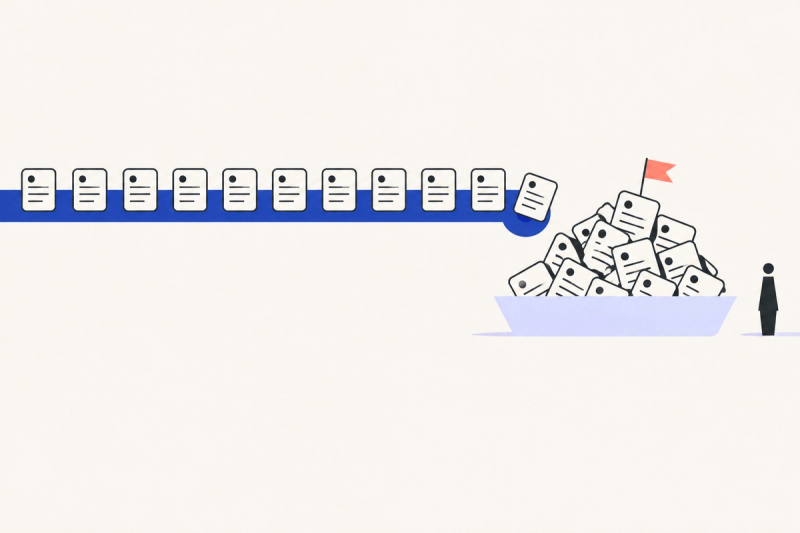
Wednesday, 7:48 a.m. You open your laptop. Overnight, your AI recruiting agent ran 23 first-round interviews across nine open roles.
That's the pitch, anyway. Last week Dayforce agreed to buy Ribbon, an AI interviewer built to run conversations at any hour. The industry is calling it the future of high-volume hiring.
Here's the part the press release skips. Twenty-three interviews happened. Which ones went wrong?
An AI recruiting agent doesn't delete work. It moves the work to 8 a.m.
So where does that morning live?
Why every AI recruiting agent creates a morning nobody planned for
Most teams plan the agent. Almost nobody plans the morning after it.
The night shift leaves no handoff note
Hospitals don't let a night shift walk out without a handoff. Recruiting does it every single day.
Take Priya, a TA lead with nine open roles, including a Senior Product Analyst. By 7:48 a.m., the agent has finished its shift:
- 23 interviews completed
- 5 reschedule requests
- 3 no-shows
- 2 flagged for odd response timing
- 1 visa question, unanswered
Priya sees the reschedules on Thursday. The visa question sits for 31 hours. At 11 a.m. the hiring manager asks where the analyst shortlist is, and Priya opens four tabs.
Night = 23 interviews.
Morning = 4 tabs.
Priya = still the bottleneck.
A flag without an owner is just noise
The agent notices unusual timing on two answers. Fine. That's a question, not a verdict.
But a question needs someone to answer it. If nobody owns the flag by 9 a.m., it turns into a rumor about a candidate. Or into a quiet no that nobody chose.
Nobody can see the whole board
Nine roles. Five places the agent's work lands: the interviewer's own dashboard, the ATS, your inbox, a scheduling thread, a Slack ping.
You're not reviewing the night. You're assembling it, tab by tab, like multiverse-reviewing.
By the time the picture is complete, it's already lunch. The candidate who asked about the visa has had no reply, and the one who reschedules twice has quietly accepted another offer.
More throughput, more loose ends
Every interview spawns something: a reschedule, a follow-up, a candidate question. The agent multiplied your events. It did not multiply your attention.
Volume went up. Hours in the day didn't. Something has to give, and it's usually the candidate at the bottom of the list.

The 3-Pile Morning: how to run an AI recruiting agent without losing the plot
You can start tomorrow with a spreadsheet and ten minutes. No new software required.
Every overnight run ends in exactly three piles.
Pile 1: Done
Finished, scored, nothing odd. You don't read these one by one. You spot-check three, then move on.
Trust, but sample.
If one spot-check turns up something strange, the whole batch moves to Pile 3. One bad interview changes what you believe about the other twenty-two. Let it.
Pile 2: Stuck
Anything the agent couldn't finish:
- Reschedules
- No-shows
- Errors
- Unanswered questions
Each row gets an owner and a time. "Me, by 10 a.m." Stuck items aren't dramatic. They're perishable. A reschedule left alone for a day quietly becomes a lost candidate.
Pile 3: Yours
Anything that needs human judgment: a flag, a borderline score, a candidate asking something only you can answer.
One rule. The agent can put a candidate in this pile. It can never take one out.
Give every pile a clock
Piles without deadlines are just folders.
- Pile 3: cleared by 9 a.m.
- Pile 2: owned by 10 a.m.
- Pile 1: sampled by noon
The clocks matter more than the labels. A flag that waits until Thursday has already become a decision, made by default.
Why this works with or without an agent
Swap the agent for a vendor, an intern, or a colleague on a different time zone. The problem is identical: work happened while you weren't looking. Three piles and three clocks fix all of them.
Your first fifteen minutes belong to Pile 3. Then Pile 2. Pile 1 can wait for coffee number two.
And a test: if you can't say how many items sit in each pile within sixty seconds, you're not running an agent. You're hoping.
The Knoot Angle
Speed at night is cheap now. Clarity at 8 a.m. is the scarce part.
Recruiters don't need more reports. They need to see what's happening right now.
That's the idea behind Knoot's Activities Dashboard. It puts the movement across all your open roles on one screen: new candidates, where each role sits in the pipeline, what's pending, what's about to slip. It's a present-tense view, not a weekly report you open after something already broke.
Make it the first thing you open. When everything lives in one place, the three piles sort themselves faster, and the Senior Product Analyst shortlist doesn't surprise you at 11 a.m.
Nothing about it asks you to change how your agent works. It just gives the morning a home.
Knoot doesn't run your night. It's where you stand when you walk in the next morning.
Let the agent work the night. You own the morning.
Content
Why every AI recruiting agent creates a morning nobody planned for
The night shift leaves no handoff note
A flag without an owner is just noise
Nobody can see the whole board
More throughput, more loose ends
The 3-Pile Morning: how to run an AI recruiting agent without losing the plot
Pile 1: Done
Pile 2: Stuck
Pile 3: Yours
Give every pile a clock
Why this works with or without an agent
The Knoot Angle