Your Best Candidate Didn't Fail Your AI Interview. They Refused to Sit It.
Your best candidates aren't failing your AI interview — they're refusing to sit it. Why front-line AI loses talent, and where AI actually belongs.

Knoot Admin
September 01, 2026
Content
Why your best candidates walk out mid-process
Good people always have options
Nobody warned them AI was in the room
AI on the front line is a signal
Put AI where it belongs: backstage, not the front door
AI does the heavy lifting, out of sight
Humans own every touchpoint
Wherever AI touches the candidate — say so
The Knoot Angle
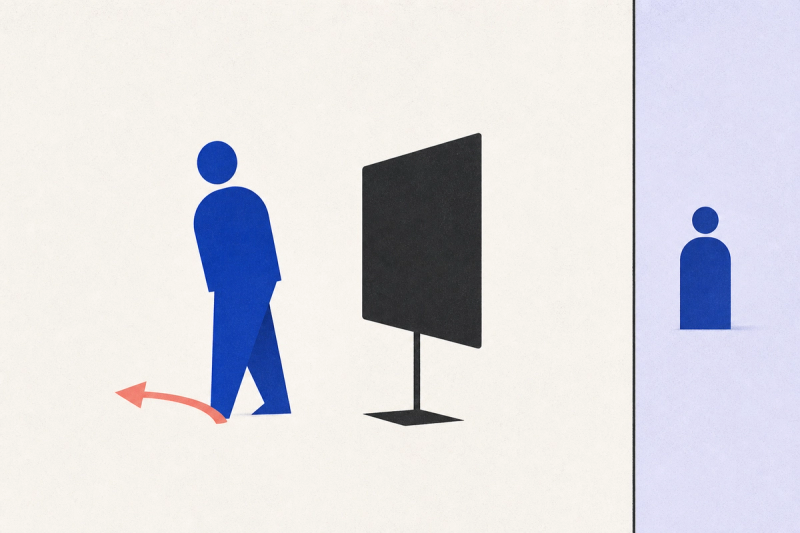
The candidate you wanted most this cycle is gone. You think they failed. They quit.
Not because your questions were hard. Because the "person" who interviewed them in round one wasn't a person. It was an AI. And nobody told them.
Recruiters in 2026 have a dangerous belief: push AI to the front line and screening gets fast. Camera turns on, bot asks, score computes. Clean.
But the front line is where a candidate decides whether to trust you.
You're not losing your best people because you lack tools. You're losing them because you put the tool in the wrong place.
Why your best candidates walk out mid-process
The candidate you actually want isn't unemployed. They're interviewing with three or four companies at once. And yours is the only one that made them talk to a webcam.
Good people always have options
A Senior Product Designer gets four callbacks.
Three of them put a human on a 30-minute call.
The fourth sends a link: 20 minutes talking into a camera, a progress bar ticking, nobody on the other end.
Guess which one they abandon halfway.
Nobody warned them AI was in the room
This is the part that breaks trust.
They sit down expecting a person. Then they realize a system is scoring them — and no one said so.
That doesn't feel modern. It feels like a setup.
AI on the front line is a signal
A glowing webcam and a progress bar. That's the entire "human" your company offered them at first contact.
The message underneath is loud:
- We're not ready to spend a real person's time on you.
- Clear the machine first.
- Attention is something you earn.
An average candidate tolerates it. A great one — someone with options — closes the tab.
You didn't filter out weak candidates faster. You chased away the strong ones faster.
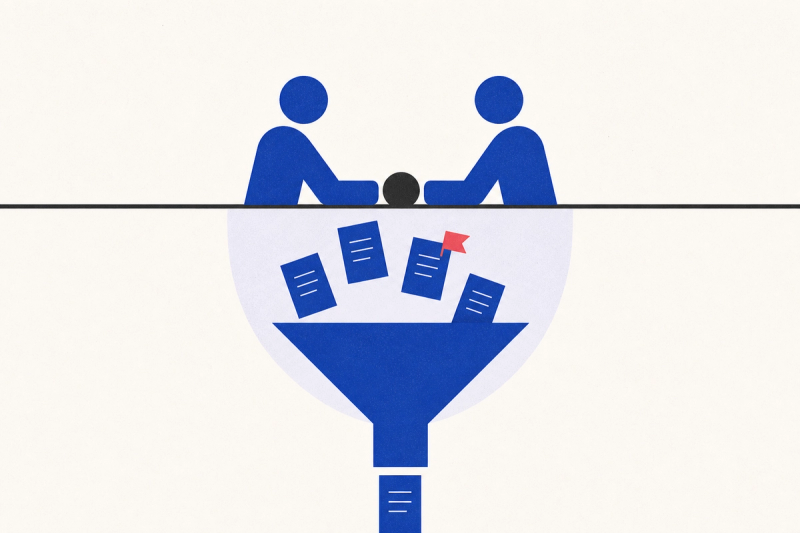
Put AI where it belongs: backstage, not the front door
AI isn't the enemy of candidate experience. Bad placement is.
There's a simple line for deciding whether a task goes to AI or stays with a human. Call it the Back-Office Line. For every step in your process, ask two questions:
1. Does the candidate see this step?
2. Does it need judgment, or just processing?
Invisible and just processing — give it to AI. Visible and needs judgment — keep it human. No exceptions.
AI does the heavy lifting, out of sight
Read 500 resumes. Rank against the JD. Flag risk. Surface the person buried on page 40.
This is work a machine does better than you, faster than you, and never gets tired doing. The candidate never sees it happen — so it costs them nothing.
Humans own every touchpoint
The interview. The offer. Even the rejection.
These are the moments a candidate remembers you by. This is where employer brand is built or burned. Don't hand it to a bot. Not ever.
Wherever AI touches the candidate — say so
Sometimes you still want AI at a touchpoint. Fine. Just disclose it first.
Transparency isn't a legal checkbox. It's how you keep your pipeline. Candidates forgive AI. They don't forgive being hidden from.
The Knoot Angle
Modern recruiting isn't a race to stuff the most AI into your process. It's a race to put AI in the one place it belongs — where it speeds you up without eating your trust.
That's the thinking behind Knoot's AI Screening module. AI Screening lives backstage, never in front of the candidate:
- Matched against JD criteria: every resume is checked against what the role actually needs, not filtered blind on keywords.
- A ranked shortlist with reasons: you see why someone made the cut, not a faceless score.
- Risk flagged, never auto-rejected: timeline overlaps, skills that don't match the experience — AI raises the signal, you make the call.
The candidate never has to talk to it. All they see is a recruiter who read their profile closely and made time to meet them like a person.
Let AI do the reading. You do the meeting.
Content
Why your best candidates walk out mid-process
Good people always have options
Nobody warned them AI was in the room
AI on the front line is a signal
Put AI where it belongs: backstage, not the front door
AI does the heavy lifting, out of sight
Humans own every touchpoint
Wherever AI touches the candidate — say so
The Knoot Angle