AI Screening Should Flag CVs, Not Reject Them
Most AI screening tools auto-reject CVs before you see them. Here's why flagging risk beats auto-reject — and why smart recruiters demand it.

Knoot Admin
May 16, 2026
Content
Your AI Screening Tool Is Rejecting Candidates. That's Why Smart Recruiters Don't Trust It.
"Auto-reject" isn't a feature. It's a liability.
Black box, no accountability
Every mistake is invisible
Hiring managers trust you, not your tool
How AI screening
The 3F Framework: Filter — Flag — Final call
Filter — eliminate on hard rules only
Flag — surface what deserves a second look
Final call — the recruiter decides
Why 3F outlasts auto-reject
The Knoot Angle
Your AI Screening Tool Is Rejecting Candidates. That's Why Smart Recruiters Don't Trust It.
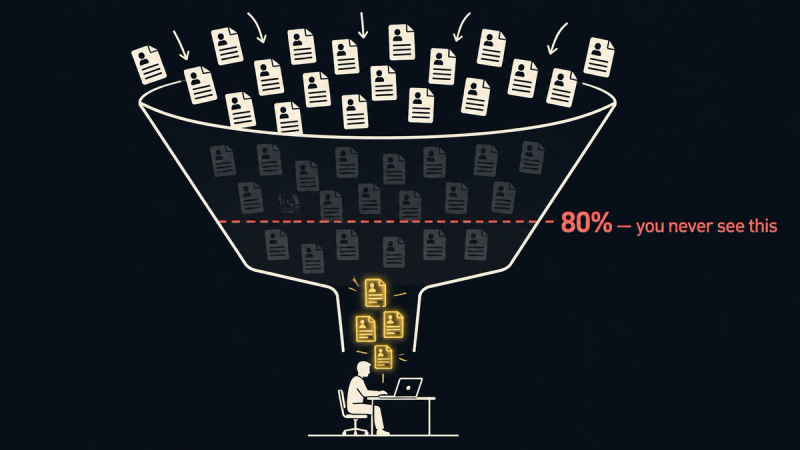
Most AI screening tools auto-reject CVs before you see them. Knoot does the opposite — flags risk, surfaces signal, lets you decide. Here's why that distinction matters.
Every AI recruiting vendor sells the same line: "Our AI eliminates 80% of unqualified candidates automatically."
It sounds like a win. Until you realize that 80% gets eliminated before your eyes ever land on it.
And every recruiter who's worked with these tools has had this moment: a hiring manager forwards a CV that "looks promising" — you check your system, and the CV was auto-rejected last week. Why? Because the title said "Backend Engineer" instead of "Software Engineer". Because of a 4-month gap. Because "Spring Boot" appeared only twice in the resume body.
AI doesn't reject bad CVs. AI rejects CVs it doesn't understand.
"Auto-reject" isn't a feature. It's a liability.
Think it through. When an AI screening tool eliminates a CV without showing it to you, what is it actually doing?
It's deciding on your behalf. Deciding a candidate doesn't deserve 30 seconds of your time. Based on a model you don't control, against criteria you can't see.
Black box, no accountability
You ask the vendor: "Why was this CV rejected?"
The answer is usually: "Match score was 42%, below the 60% threshold."
That's not a reason. That's a number.
A working recruiter needs to know: was the score low because of a missing skill, an unusual timeline, or a JD that was written too narrowly? The three answers point to three different actions.
Every mistake is invisible
When AI auto-rejects, false negatives never make it back to your desk.
The career-switcher with transferable experience? You don't see them.
The candidate with a 6-month gap explained by parental leave? Gone before you notice.
The senior who used different job titles at three companies for the same role? Filtered.
You only see what the AI lets you see. That's not screening. It's structured blindness.
Hiring managers trust you, not your tool
When the hiring manager asks why the shortlist looks junior, "the AI filtered them out" is not a defense.
You own the shortlist. Tools are tools. They're not scapegoats.
How AI screening should work: flag, don't reject
Simple principle, rarely implemented: AI surfaces signal, the human makes calls.
Every CV still lands on your desk. But it arrives with a layer of analysis already done, so you decide faster — not less often.
The 3F Framework: Filter — Flag — Final call
Works with any AI screening tool. Works without one, too. Even with a spreadsheet and a careful eye.
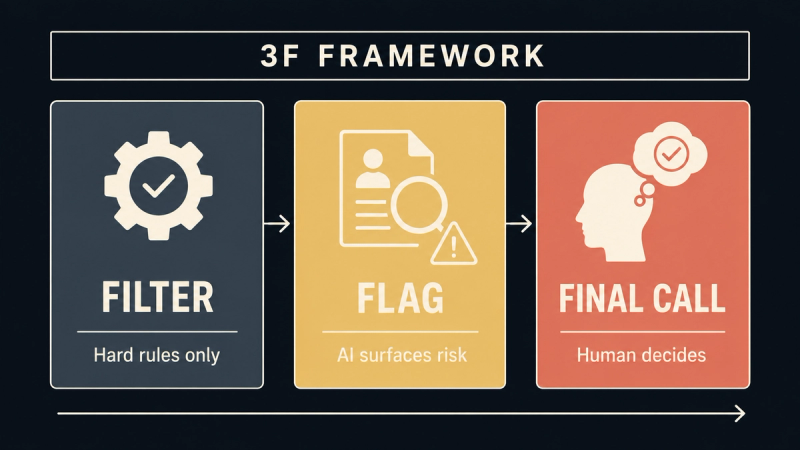
Filter — eliminate on hard rules only
This is the only piece AI gets to "automate". But only with criteria that are measurable and pre-approved by you:
- Wrong location for a non-remote role
- No work authorization
- Salary expectations far outside the range
This isn't judgment. It's mechanical filtering. You sign off in advance, the system executes.
Flag — surface what deserves a second look
This is where AI generates real value, and where most tools get it wrong.
AI reads every CV and tags signals:
- Timeline overlaps that don't add up
- Skills claimed that don't match the actual job history
- Title jumps that look unusual (Junior to Director in 18 months)
- Unexplained employment gaps
Every flag comes with a concrete reason. Not "42% match". But: "Candidate lists 5 years of Spring Boot, but the first role (2022–2024) at Company A was Frontend Developer — verify in the interview."
Final call — the recruiter decides
Which CV makes the shortlist, which gets rejected, which moves to interview — that's always you.
AI lets you read 100 CVs in the time you used to spend on 20. The decision stays with the person accountable for the hire.
Why 3F outlasts auto-reject
Auto-reject optimizes for short-term speed — fewer CVs to look at, less work.
3F optimizes for long-term quality — you build pattern recognition on your candidate pool, on JDs that are too narrow, on biases hiding in your own criteria.
A recruiter using 3F for six months learns which of their own JDs are written badly. A recruiter on auto-reject for six months just knows the tool filters 80%. They don't know if that 80% was right.
The Knoot Angle
The difference between AI screening that flags and AI screening that rejects isn't a feature gap. It's a philosophy gap. One treats recruiters as decision-makers. The other treats them as approvers of decisions a machine already made.
Knoot picked the first one, and we don't compromise on it.
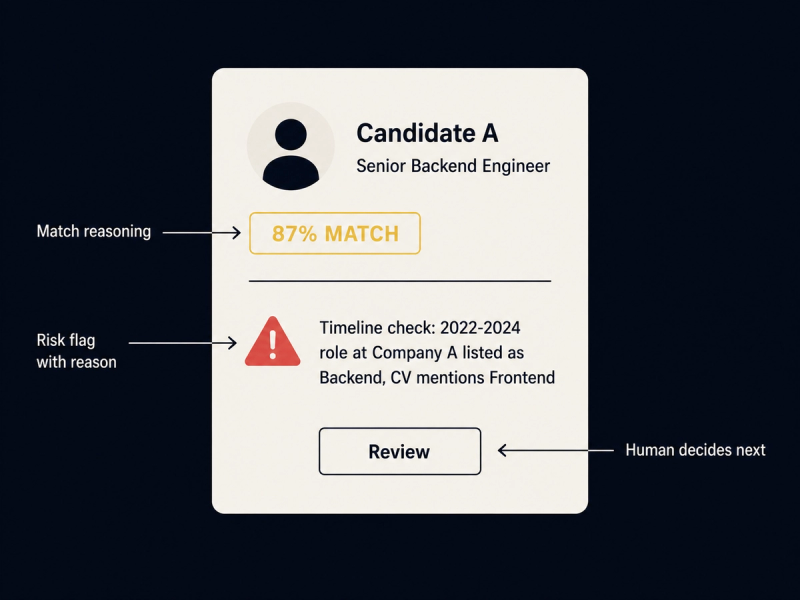
Knoot's AI Screening works like this: every CV is analyzed against the JD already broken down by JD Analyzer, then the system surfaces a ranked shortlist with concrete match reasoning for each candidate — alongside flags for risk signals like fake experience, timeline overlaps, and skill claims that contradict the work history. Every flag has an explanation. No hollow "42% match" scores.
Most importantly: no CV gets rejected on your behalf. You see the entire pool. AI just marks where you should look closer.
Let AI handle the pattern recognition. You handle the call.
Content
Your AI Screening Tool Is Rejecting Candidates. That's Why Smart Recruiters Don't Trust It.
"Auto-reject" isn't a feature. It's a liability.
Black box, no accountability
Every mistake is invisible
Hiring managers trust you, not your tool
How AI screening
The 3F Framework: Filter — Flag — Final call
Filter — eliminate on hard rules only
Flag — surface what deserves a second look
Final call — the recruiter decides
Why 3F outlasts auto-reject
The Knoot Angle